
Ultimately, all learning in schools comes back to vocabulary knowledge. Explicitly teaching vocabulary can enrich knowledge and understanding in a range of subject domains.
-
There is a strong reciprocal relationship between word knowledge and reading comprehension. (National Reading Panel 2000, Biemiller 2003)
-
Children who read more will come across a greater number of words and get more practice at decoding words and have greater opportunities to enhance their knowledge of morphology and spelling than less avid readers. (Cain and Oakhill 2011)
-
Learning new words is a cumulative task that takes place gradually over time. (Nagy and Scott 2000 )
Closing the Vocabulary Gap:
-
Becker (1977) identified poor vocabulary knowledge as the primary cause of academic failure of disadvantaged students
-
Children’s declining reading comprehension compared to more able peers from age 8 onwards largely results from a lack of vocabulary knowledge (Becker 1977)
-
Pupils’ acquisition and command of vocabulary are key to their learning and progress across the whole curriculum. Teachers should therefore develop vocabulary actively, building systematically on pupils’ current knowledge. They should increase pupils’ store of words in general
-
Read harder texts
-
“Close read” texts rigorously and intentionally
-
Read more nonfiction effectively
Explicit teaching of academic vocabulary in every subject area enhances students’ awareness and understanding of academic language in schools:
-
Explicit teaching of vocab occurs often – daily – and focuses on a limited number of words.
-
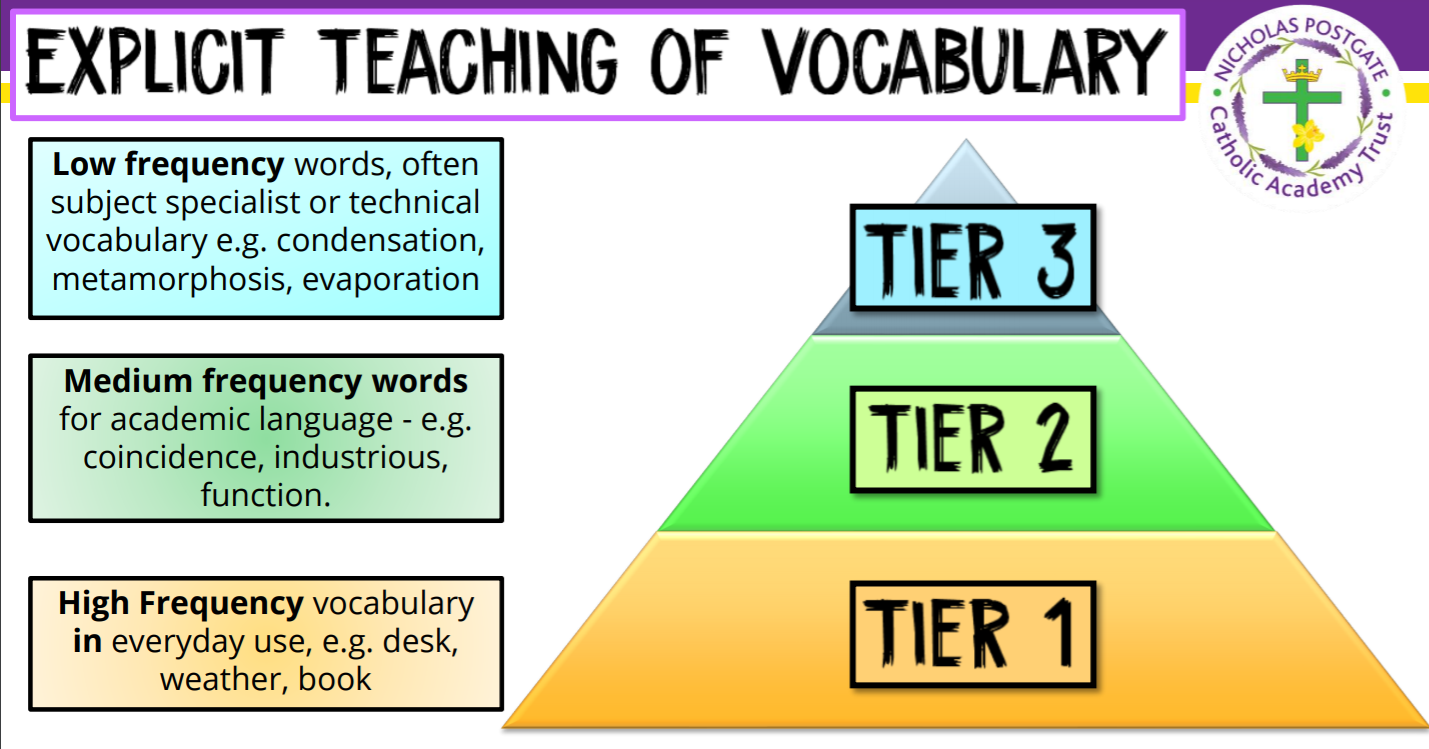
It’s critical to focus vocab instruction on words that children won’t hear in conversation – robust words that children are less likely to hear every day.
-
Written language contains far more vocabulary words than oral language. In fact, most of the words that comprise a student’s reading vocabulary will appear in their lives only in written texts.
Implicit teaching of vocabulary is also very important. Ensuring that implicit teaching is planned into lessons where appropriate.
This occurs as an expectation at St Patrick’s Catholic College on a regular basis. The Teacher should verbally tell pupils what a word means based upon their planning and prediction of barriers that are increasing the vocabulary gap
